

It’s 2026, and you’re scrolling through Instagram when you see a post from a billionaire in Byron Bay-living in a $12 million beachfront villa… and he’s renting it. You pause. Why? If you have tens of millions, why not just buy? Why rent? The answer isn’t about saving money. It’s about control, flexibility, and strategy. And it’s more common than you think.
They’re not avoiding ownership-they’re optimizing it
Millionaires don’t rent because they can’t afford to buy. They rent because buying doesn’t always make sense. Owning a home means locking up capital. That $8 million you spend on a Sydney waterfront property? It’s gone. Tied up in bricks and mortar. You can’t easily move it, sell it fast, or use it as fuel for another investment. Renting? That same $8 million stays liquid. It’s in stocks, private equity, or a new startup. And that’s where the real returns happen.Take a tech founder in Melbourne. He owns three companies. He doesn’t need to own a house. He needs to own options, patents, and cash flow. Renting a $15,000-a-month penthouse gives him access to luxury without the headaches of property management, council rates, or fixing a leaking roof at 2 a.m. He pays for convenience, not ownership.
Flexibility beats permanence
The world doesn’t stay still. Jobs move. Families shift. Markets change. A millionaire in Sydney might be here for three years because of a board appointment. In five years, he could be running operations in Singapore or Zurich. Buying a villa in Double Bay locks him into a location he might not want to stay in. Renting? He signs a 12-month lease, gives 30 days’ notice, and walks away. No selling costs. No market timing. No stress.According to a 2024 report from Knight Frank, 38% of ultra-high-net-worth individuals in Australia chose to rent their primary residence for more than five years. Why? Because they travel. Because they want to test markets. Because they don’t want to be tied to one city while their businesses operate globally.
They avoid the hidden costs of ownership
People think owning a home is cheaper. But look closer. Property taxes. Insurance. Maintenance. Pest control. Landscaping. Pool cleaning. HVAC servicing. Strata fees. In a luxury villa, these aren’t minor expenses. They’re full-time jobs.One client I worked with in Mosman spent $180,000 last year on upkeep for his $14 million home. That’s $15,000 a month. He was renting before. Now he’s renting again. Why? Because the rental agreement included all of that-cleaning, gardening, repairs, even security monitoring. He paid $12,000 a month. That’s $6,000 less than what he was spending just to maintain the place he owned.
And let’s not forget depreciation. A luxury home doesn’t appreciate like a stock. It loses value over time. Furniture, finishes, smart systems-those all degrade. A rental property? The landlord handles replacement. The tenant gets the latest tech without paying for it.
Tax advantages you didn’t know about
In Australia, if you own a home and live in it, you don’t pay capital gains tax when you sell. Sounds great, right? But here’s the twist: if you’re a business owner or investor, your primary residence doesn’t generate income. It’s a cost center. Renting lets you claim deductions you can’t get with ownership.For example, a millionaire who rents can structure his housing allowance as part of his company’s expense. If he’s the CEO of a private company, the business can pay his rent directly. That’s a tax-deductible expense. The same money, spent on a mortgage, isn’t deductible. That’s a massive difference over time.
And then there’s the estate planning angle. If you own a villa, it becomes part of your estate. That means probate, potential capital gains tax on heirs, and legal battles over inheritance. Renting? The lease ends. The property stays with the owner. No legal mess. No family drama. Just clean, simple transitions.
Access to better locations without the commitment
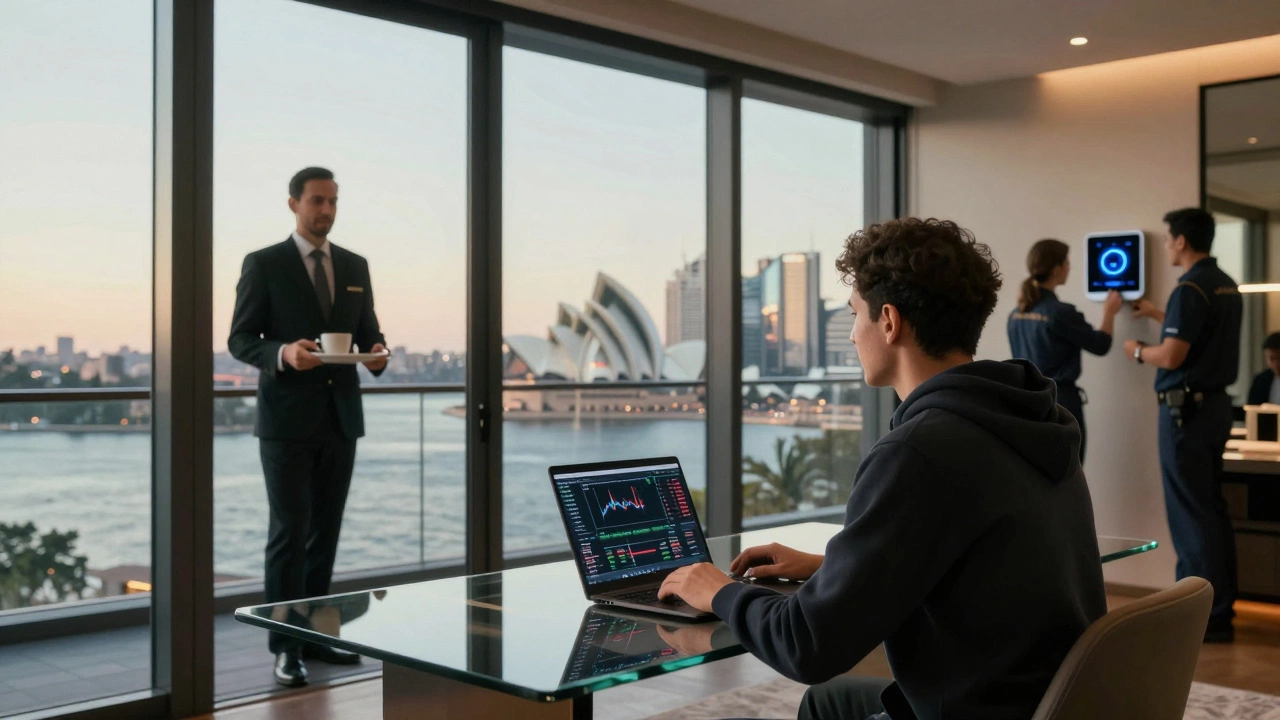
Want to live in a villa with a private helipad in the Blue Mountains? Or a penthouse with 360-degree views over Sydney Harbour? Or a beachfront estate with a saltwater pool and underground wine cellar? You can rent these places for a year. Try them out. See if the lifestyle fits. Then move on.Buying? You’re stuck. Even if the market crashes, you still own it. Renting lets you sample luxury without the risk. It’s like test-driving a Ferrari before you buy. Only instead of a car, you’re testing a way of life.
High-end rental markets in Australia are booming. In 2025, there were over 2,300 luxury rentals listed in Sydney alone with monthly rents above $10,000. Many of them are owned by institutional investors-super funds, private equity firms, offshore families-who rent them out because they’re better off collecting monthly income than holding illiquid assets.

It’s not about being broke-it’s about being smart
The myth that rich people must own homes is outdated. The new playbook is: own what generates returns. Rent what consumes them.A home is a lifestyle product. A stock portfolio is an asset. A rental property you own? That’s an asset. But the house you live in? Unless you’re flipping it, it’s just a place to sleep. And if you’re a millionaire, your time is worth more than maintaining a property.
Think of it this way: if you earn $5 million a year, spending 40 hours a month fixing a broken pool pump doesn’t make sense. Paying someone else to do it? That’s a business decision. Renting lets you outsource the entire burden.
What about the emotional side?
Some say, “But I want to own something permanent.” Fair point. But permanence isn’t the same as stability. Many millionaires rent the same luxury property for 10, 15, even 20 years. They don’t need to own it to feel rooted. They build relationships with landlords, staff, and communities. They create memories. They just don’t need a title deed to prove it.There’s also a psychological shift happening. Younger billionaires-those who made their money in tech, crypto, or AI-are less attached to traditional symbols of wealth. They don’t need a mansion to prove they made it. They need freedom. And freedom means not being tied down.
It’s not for everyone
This isn’t a universal rule. If you’re planning to stay in one place for 20 years, buying still makes sense. If you have kids in local schools, or you’re building a legacy, ownership matters. But if your life is dynamic, your business is global, and your capital is working harder elsewhere-renting isn’t a compromise. It’s a strategy.The real question isn’t “Why rent?” It’s “Why own if you don’t have to?”
Do millionaires ever regret renting instead of buying?
Rarely. Those who rent typically do so intentionally. They weigh the trade-offs: liquidity vs. stability, flexibility vs. permanence. Most find that the benefits-like avoiding maintenance costs, retaining investment capital, and staying mobile-outweigh the emotional comfort of ownership. A 2023 survey of 400 Australian high-net-worth individuals found that 72% said they’d choose to rent again if given the choice.
Can renting be a better investment than buying a home?
Yes, if you’re comparing the return on your capital. If you spend $10 million on a villa, that money is locked up. If you rent the same villa for $12,000 a month and invest the $10 million in a diversified portfolio averaging 8% annual returns, you’re making $800,000 a year. That’s far more than any home appreciation could realistically offer, especially after taxes and upkeep. The math favors renting for those with capital to deploy.
Are luxury rentals in Australia hard to find?
Not anymore. The market has matured. In Sydney, Melbourne, and Perth, there are now dedicated luxury rental agencies that manage properties worth $5 million to $50 million. These aren’t short-term Airbnb listings-they’re long-term leases with full-service management, concierge, security, and even private chefs on call. Properties are often owned by institutional investors who treat them like commercial assets.
Do banks or lenders look down on people who rent instead of own?
No. In fact, banks often prefer clients who rent. Why? Because they’re more likely to have stable income, liquid assets, and lower debt-to-income ratios. Lenders don’t care if you own your home-they care if you can repay a loan. A millionaire who rents and has $20 million in investments is seen as a low-risk borrower, not a risky one.
Is renting a luxury home cheaper than owning one?
It depends. If you’re comparing the monthly mortgage payment to the rent, renting might seem more expensive. But when you factor in property taxes, insurance, repairs, landscaping, security, and maintenance-renting often costs less. One Sydney homeowner spent $210,000 a year on upkeep. His rental equivalent cost $144,000. The difference? $66,000 in savings. And that’s before considering the opportunity cost of tied-up capital.
The idea that wealth means owning a big house is fading. The new standard is freedom-freedom to move, freedom to invest, freedom to live without the weight of property management. Millionaires aren’t avoiding ownership. They’re choosing smarter ways to live.