
Credit Card Minimum Payment Calculator
Your Details
Results
- Monthly Interest Charged: $0.00
- Principal Reduction: $0.00
- Time to Pay Off (Min Only): Calculating...
- Total Cost of Debt: $0.00
You just checked your statement. The total balance is $3,000. You’re worried about how much you actually have to pay this month to keep things in order. It’s a common question, and the answer isn’t as simple as “just pay the full amount.” While paying the full balance is always the smartest financial move, life happens, and sometimes you can only afford the minimum. Knowing exactly what that number is-and understanding the hidden costs behind it-can save you hundreds of dollars in interest over time.
The short answer? For most standard credit cards, the minimum payment on a $3,000 balance will likely fall between $90 and $150. However, this number varies wildly depending on your specific card issuer, your interest rate, and whether you’ve made any payments since the last billing cycle. Let’s break down how banks calculate this figure so you aren’t guessing when the bill arrives.
How Banks Calculate Your Minimum Payment
Credit card issuers don’t just pick a random number out of thin air. They use a formula designed to ensure they get paid back eventually while keeping you in the debt cycle longer if you only pay the minimum. Most major banks use one of two methods: a percentage-based calculation or a flat-fee structure.
The most common method is the percentage-based minimum. Typically, this requires you to pay 1% to 3% of your total outstanding balance. If your card uses a 2% threshold, your minimum payment on a $3,000 balance would be exactly $60. But wait-it’s rarely that clean. Many cards add a small fixed fee, often around $25 to $35, to that percentage. So, using the same example: 2% of $3,000 is $60, plus a $25 floor fee equals an $85 minimum payment.
Some issuers, particularly those offering premium rewards cards, might use a slightly higher percentage, such as 3%. In that case, 3% of $3,000 is $90. If there’s no additional fixed fee, your minimum is $90. If there is a $25 fee added, it becomes $115. This variation is why checking your specific cardholder agreement is crucial; generic advice can sometimes lead to unexpected shortfalls.
The Hidden Cost: Interest and the Average Daily Balance
Here’s where it gets tricky. Your minimum payment doesn’t just cover part of your principal ($3,000). A significant chunk goes toward paying off the interest accrued during the billing period. To understand this, you need to know your Average Daily Balance (ADB).
Let’s say your Annual Percentage Rate (APR) is 24%, which is a common rate for many consumer credit cards today. This translates to a monthly interest rate of roughly 2%. If you carried a $3,000 balance for the entire month without making any interim payments, you’d owe about $60 in interest alone before you even touch the principal.
If your minimum payment is calculated at $90 (3% of the balance), here’s the breakdown:
- Total Minimum Payment: $90
- Interest Charged: ~$60
- Principal Reduction: ~$30
See the problem? You paid $90, but your actual debt only dropped by $30. That means next month, you’re still carrying nearly $2,970 in principal, and interest will continue to compound on that remaining amount. This is known as the "interest trap," and it’s the primary reason why paying only the minimum can extend a $3,000 debt into a multi-year commitment costing thousands in extra fees.
Why Your Statement Might Show a Different Number
Have you ever seen a minimum payment that seemed too low or too high compared to your estimate? There are a few factors that influence the final number on your statement:
- Interim Payments: If you paid $500 mid-cycle, your average daily balance drops significantly. This reduces the interest charged, meaning more of your minimum payment goes toward the principal. Some issuers recalculate the minimum based on the new lower balance.
- Promotional Periods: If you’re in a 0% APR introductory period, your minimum payment might be purely percentage-based with no interest component, making it cheaper in the short term but potentially larger in absolute value if the percentage is high.
- Late Fees and Penalties: If you missed a payment last month, penalty APRs can kick in, raising your rate to 29.99% or higher. This increases the interest portion of your minimum payment, leaving less to reduce the principal.
It’s also worth noting that some banks have a "floor" minimum. Even if 1% of your balance is $30, they might require a minimum of $25 regardless. Conversely, if your balance is very large, some cards cap the percentage at a certain dollar amount to prevent the minimum from becoming unmanageably high, though this is less common for balances under $10,000.
Strategies to Pay Off ,000 Faster
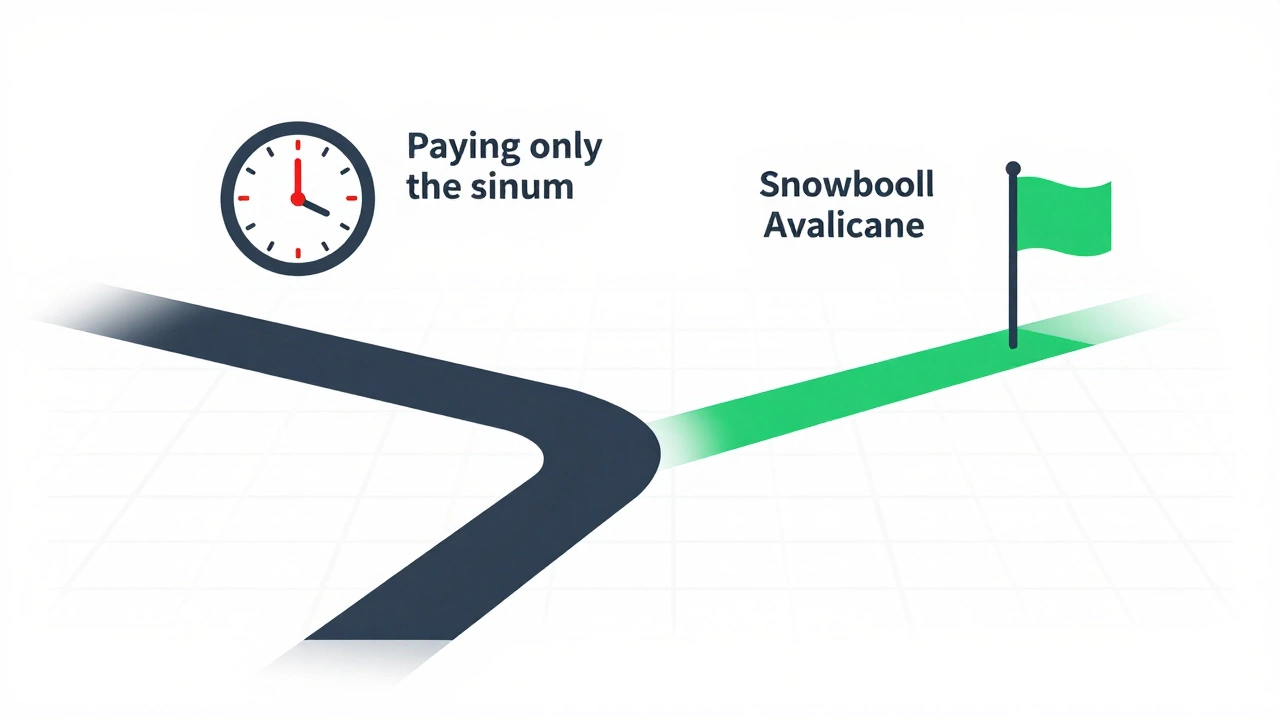
Knowing your minimum payment is step one. Step two is deciding how to handle it. Here are three practical approaches to tackle a $3,000 credit card balance:
1. The Snowball Method
This psychological approach focuses on momentum. List all your debts from smallest to largest. Pay the minimum on everything except the smallest debt. Throw every extra dollar you have at that smallest balance. Once it’s gone, roll that payment amount into the next smallest debt. For a single $3,000 card, this means treating it as your sole focus and aiming to pay at least $100-$150 more than the minimum each month.
2. The Avalanche Method
This is the mathematically superior option. Focus on the debt with the highest interest rate first. If your $3,000 card has a 24% APR and another card has 15%, put all extra funds toward the 24% card. You’ll save more money on interest over time, even if it takes longer to see the first account hit zero.
3. Balance Transfer Cards
If you have good credit, consider transferring the $3,000 to a card with a 0% APR intro period (usually 12-18 months). You’ll still have to make minimum payments, but since there’s no interest, 100% of your payment goes toward the principal. Just watch out for transfer fees, typically 3-5% of the amount transferred ($90-$150 in this case).
| Monthly Payment | Time to Pay Off | Total Interest Paid | Total Amount Paid |
|---|---|---|---|
| Minimum Only (~$90) | ~8 years | ~$2,800 | ~$5,800 |
| $150/month | ~2.5 years | ~$600 | ~$3,600 |
| $250/month | ~1.2 years | ~$180 | ~$3,180 |
As you can see, increasing your monthly payment by just $60 over the minimum saves you over $2,000 in interest and shaves six years off your payoff timeline. That’s real money back in your pocket.
Common Mistakes to Avoid
When dealing with credit card debt, small errors can lead to big problems. Here’s what to watch out for:
- Paying Exactly the Minimum: As shown above, this extends your debt indefinitely. Always aim to pay at least $25-$50 more than required.
- Ignoring Due Dates: Missing a payment triggers late fees ($25-$40) and can spike your APR. Set up autopay for at least the minimum amount to avoid this.
- New Purchases: Adding new charges to a card you’re trying to pay off resets the grace period on those new purchases and increases your average daily balance, leading to more interest.
It’s also important to monitor your Credit Utilization Ratio. This is the amount of credit you’re using divided by your total limit. If your limit is $5,000 and you carry a $3,000 balance, your utilization is 60%. Lenders prefer this number below 30%. High utilization can lower your credit score, making future loans more expensive. Paying down the balance before the statement closes can help improve this metric.
Understanding your minimum payment is just the beginning. By knowing how it’s calculated and taking proactive steps to pay more than the bare minimum, you take control of your finances instead of letting the bank dictate your budget. Whether you choose the snowball, avalanche, or balance transfer route, consistency is key. Every extra dollar you pay now is a dollar you won’t owe later.
What happens if I miss my minimum payment?
Missing your minimum payment results in a late fee, typically ranging from $25 to $40. More importantly, it can trigger a penalty APR, raising your interest rate to nearly 30%. It may also be reported to credit bureaus, negatively impacting your credit score.
Does the minimum payment include interest?
Yes. The minimum payment covers the interest accrued during the billing period plus a small portion of the principal. If you only pay the minimum, most of your payment goes toward interest, not reducing the actual debt.
How long does it take to pay off $3,000 at the minimum?
At a typical 24% APR and a 3% minimum payment, it could take over 8 years to pay off a $3,000 balance, costing you nearly $3,000 in interest. Increasing your monthly payment significantly reduces this timeline.
Can I negotiate my minimum payment?
Generally, no. Minimum payments are set by contract terms. However, if you’re struggling financially, you can contact your issuer to discuss hardship programs, which might temporarily lower your rate or adjust payment terms, though this may affect your credit report.
Is it better to pay multiple credit cards or focus on one?
Financially, focusing on the card with the highest interest rate (Avalanche method) saves the most money. Psychologically, paying off the smallest balance first (Snowball method) provides quick wins and motivation. Choose the method that keeps you consistent.