

Villa vs. Mansion Lifestyle Matcher
Answer these three key questions based on the article's criteria to find out which luxury property style aligns best with your life.
Your Match Result
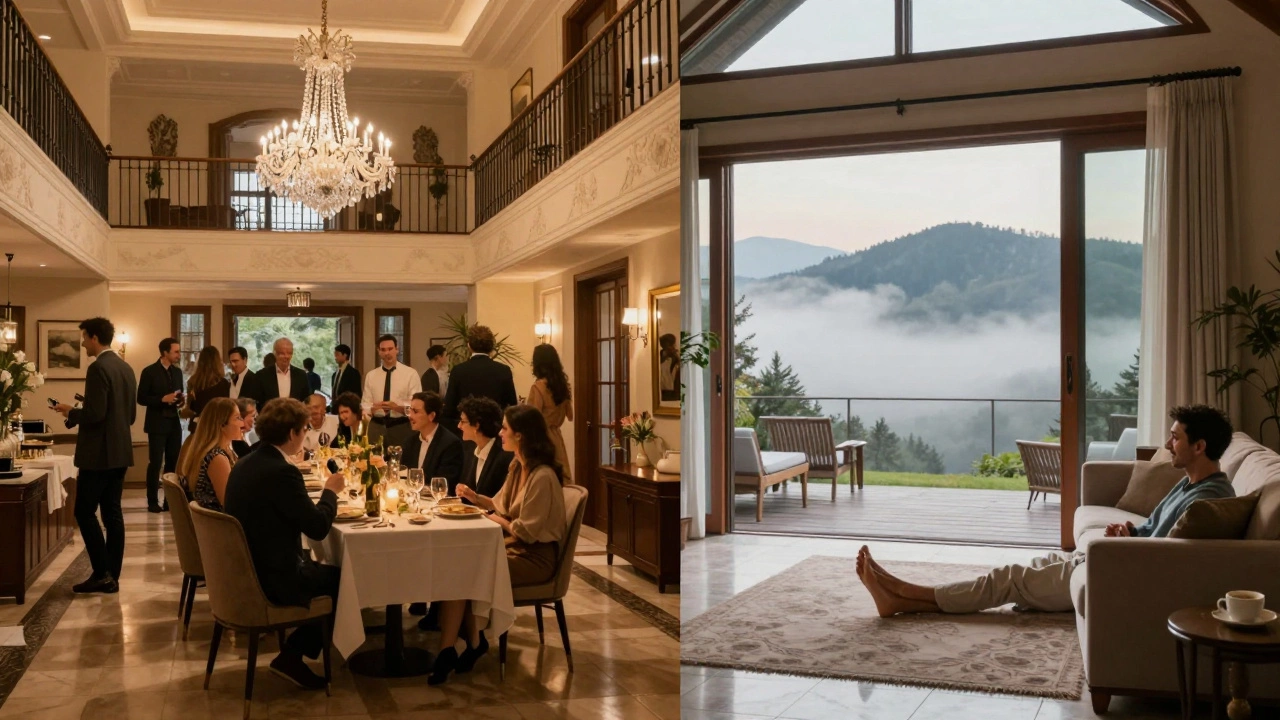
You walk through the front gate of a sprawling estate. The driveway winds past manicured hedges, leading to a structure that looks like it belongs in a movie from the 1920s. High ceilings, grand staircases, and enough rooms to house an entire extended family. This is a mansion, defined by its sheer scale and formal grandeur. Now, imagine a different scene. A sleek, low-profile home nestled into a hillside or perched on a cliff edge. It’s smaller, yes, but every window frames a breathtaking view. The layout feels open, relaxed, and deeply connected to the outdoors. This is a villa, prioritizing lifestyle, privacy, and architectural harmony with nature.
The question isn’t really about which one is “better.” That’s like asking if a sports car is better than a luxury sedan. It depends entirely on where you’re going and how you want to get there. When you are looking at villas for sale versus mansions, you are choosing between two fundamentally different ways of living. One offers opulence and space; the other offers intimacy and atmosphere. Let’s break down what actually drives these differences so you can make a decision based on your life, not just the size of the floor plan.
Defining the Difference: Scale vs. Style
To understand why one might suit you over the other, we first need to strip away the marketing fluff. In real estate terms, these words carry specific weight regarding layout, history, and intended use.
A mansion is primarily defined by size. While there is no universal legal definition, industry standards generally consider a home a mansion if it exceeds 8,000 square feet (roughly 740 square meters). These properties often feature formal architecture-think columns, symmetrical facades, and grand entryways. They are designed to impress visitors and host large gatherings. The focus is inward: the house itself is the statement.
A villa, on the other hand, is defined by style and setting. Originating from Roman country houses, modern villas are typically single-family homes located in scenic or rural settings. They range from 2,500 to 6,000 square feet. Their design emphasizes indoor-outdoor living, with features like terraces, pools, and large glass walls that blur the line between inside and outside. The focus is outward: the environment is the statement.
| Feature | Mansion | Villa |
|---|---|---|
| Primary Focus | Grandeur, Space, Formality | Lifestyle, Privacy, Nature |
| Typical Size | 8,000+ sq ft (740+ sq m) | 2,500 - 6,000 sq ft (230 - 550 sq m) |
| Architecture | Symmetrical, Classical, Ornate | Modern, Rustic, Integrated with Landscape |
| Location | Urban estates, Suburban cul-de-sacs | Coastal, Mountain, Rural, Secluded |
| Maintenance Level | High (Staff required) | Moderate to High (Manageable) |
The Lifestyle Factor: Who Are You Living For?
Your daily routine will dictate whether a mansion or a villa makes sense. Consider how you spend your weekends. If your ideal Saturday involves hosting a dinner party for twenty people, complete with a live band in the foyer and guests staying overnight in guest suites, a mansion provides the necessary infrastructure. It has separate wings, multiple kitchens, and service entrances that allow staff to work without disturbing guests.
However, if your ideal Saturday is waking up without an alarm, walking barefoot onto a terrace, and watching the sunrise over the ocean while drinking coffee, a villa is the clear winner. Villas are designed for relaxation. They don’t force you to entertain unless you want to. The layout encourages quiet moments, reading in a sunroom, or swimming in a private pool. It’s a retreat, not a venue.
Think about your social circle too. Mansions often attract a certain type of social dynamic-one centered around status and networking. Villas tend to attract those seeking escape and tranquility. If you value privacy above all else, a villa’s secluded location usually offers more genuine seclusion than a mansion hidden behind high walls in a busy suburb.
Financial Realities: Purchase Price and Hidden Costs
Let’s talk money, because this is where many buyers get tripped up. Generally, mansions command a higher purchase price due to their size and land requirements. However, the total cost of ownership tells a more complex story.
Property taxes for a mansion can be astronomical. Because they are valued higher and occupy more land, annual tax bills can easily exceed six figures. Insurance premiums are also significantly higher due to the increased risk exposure and replacement costs of unique architectural features.
Villas have lower upfront costs and tax burdens, but they come with their own financial considerations. High-end villas often require specialized maintenance for outdoor features. Think pool heating systems, landscape irrigation, and exterior materials exposed to salt air or mountain weather. While cheaper than a mansion, a luxury villa still demands a substantial budget for upkeep.
Resale value is another critical factor. Mansions have a very small buyer pool. There are far fewer people who can afford and desire an 8,000-square-foot home. This means longer time on the market and potentially steeper price drops during economic downturns. Villas, particularly those in desirable locations like coastal areas or near major cities, tend to hold value better because they appeal to a broader range of luxury buyers-including second-home purchasers and vacationers.

Maintenance and Staffing: The Invisible Workforce
This is the biggest shock for new luxury homeowners. A mansion is not just a house; it’s a small operation. To keep a mansion running smoothly, you almost certainly need full-time staff. We’re talking about a house manager, several cleaners, a gardener, and possibly a chef or driver. Managing employees adds a layer of complexity that many buyers underestimate. You become a business owner as much as a homeowner.
Villas are more manageable. While you may hire weekly cleaning services or a part-time gardener, you likely won’t need a full staff living on-site. This reduces liability, payroll headaches, and the need for extensive security protocols for employee access. For someone who wants to enjoy their home without managing a workforce, a villa offers a much simpler lifestyle.
Architectural Integrity and Renovation Potential
If you love history, a mansion might be your dream. Many mansions are built with traditional methods using high-quality materials like solid oak, marble, and plaster. Restoring a historic mansion can be a rewarding project, preserving craftsmanship that is lost in modern construction. However, renovations are expensive and heavily regulated. You can’t just knock down a wall because it doesn’t fit your open-plan kitchen idea.
Villas offer more flexibility. Modern villas are often designed with modular layouts that can be adapted to changing needs. Older villas, especially those in Mediterranean or European styles, also allow for significant customization. You can expand a terrace, add a wine cellar, or reconfigure interior spaces with relative ease compared to the rigid structures of many mansions. If you plan to customize your home extensively, a villa gives you more creative freedom.
Location and Accessibility
Where you live matters just as much as what you live in. Mansions are often found in established, affluent suburbs or urban estates. This means proximity to top-tier schools, hospitals, and shopping centers. You get luxury living without sacrificing convenience. Commutes might be short, and amenities are always nearby.
Villas are frequently located in more remote or scenic areas. Think beachfronts, mountain ridges, or countryside estates. This isolation is part of the appeal, but it comes with trade-offs. Grocery runs take longer. Emergency services might be farther away. Internet connectivity can be spotty in rural villa locations. If you work remotely or rely on quick access to city amenities, a villa’s location could become a frustration rather than a perk.
Which One Fits Your Future?
Choosing between a villa and a mansion isn’t about prestige; it’s about alignment. Ask yourself these three questions:
- Do I want to entertain formally or relax privately? If you crave grand parties, choose a mansion. If you seek peace and quiet, choose a villa.
- Am I prepared to manage staff and high operational costs? If yes, a mansion works. If you prefer simplicity, a villa is better.
- Is my priority immediate convenience or long-term appreciation? Mansions offer immediate urban/suburban convenience. Villas often offer better long-term appreciation in desirable natural settings.
There is no wrong answer here, only a right answer for your specific stage of life. A young couple might prefer the manageable scale of a villa, while a multi-generational family might need the space of a mansion. Evaluate your needs honestly, and let your lifestyle guide your choice, not the label on the brochure.
Is a villa considered a luxury home?
Yes, absolutely. While "villa" originally referred to modest country houses, in modern real estate, it denotes a high-end, standalone residence often featuring premium finishes, private grounds, and scenic locations. Villas are firmly in the luxury category, though they may be smaller than mansions.
What is the minimum square footage for a mansion?
There is no legal definition, but most real estate experts and appraisers consider a home a mansion if it is at least 8,000 square feet (approximately 740 square meters). Some stricter definitions require 10,000 square feet or more.
Are villas easier to sell than mansions?
Generally, yes. Villas appeal to a broader market, including second-home buyers, retirees, and professionals seeking privacy. Mansions have a very niche buyer pool, which can lead to longer listing times and greater price volatility during market shifts.
Can a villa be located in a city?
Yes, though less commonly. Urban villas exist, often characterized by townhouse-style designs with private courtyards or rooftop terraces. However, the traditional villa concept is tied to suburban, rural, or coastal settings where space allows for integration with nature.
Do mansions require more insurance than villas?
Yes. Due to their larger size, higher replacement costs, and often more elaborate architectural features, mansions typically incur significantly higher insurance premiums. They may also require specialized coverage for art collections, pools, and other luxury amenities.