

Commercial Loan Down Payment Calculator
Loan Configuration
Estimated Requirements
Down Payment
$200,000
Loan Amount
$800,000
You walk into the bank ready to buy that warehouse or office building, and the first thing they ask is how much cash you have on hand. For residential mortgages, you might remember paying 3% or even 0% down. That world feels like a different planet when it comes to commercial loans are financing instruments used to purchase income-producing real estate such as offices, retail spaces, industrial properties, and multifamily buildings with five or more units. The rules here are stricter, the risks are higher, and the lenders want skin in the game.
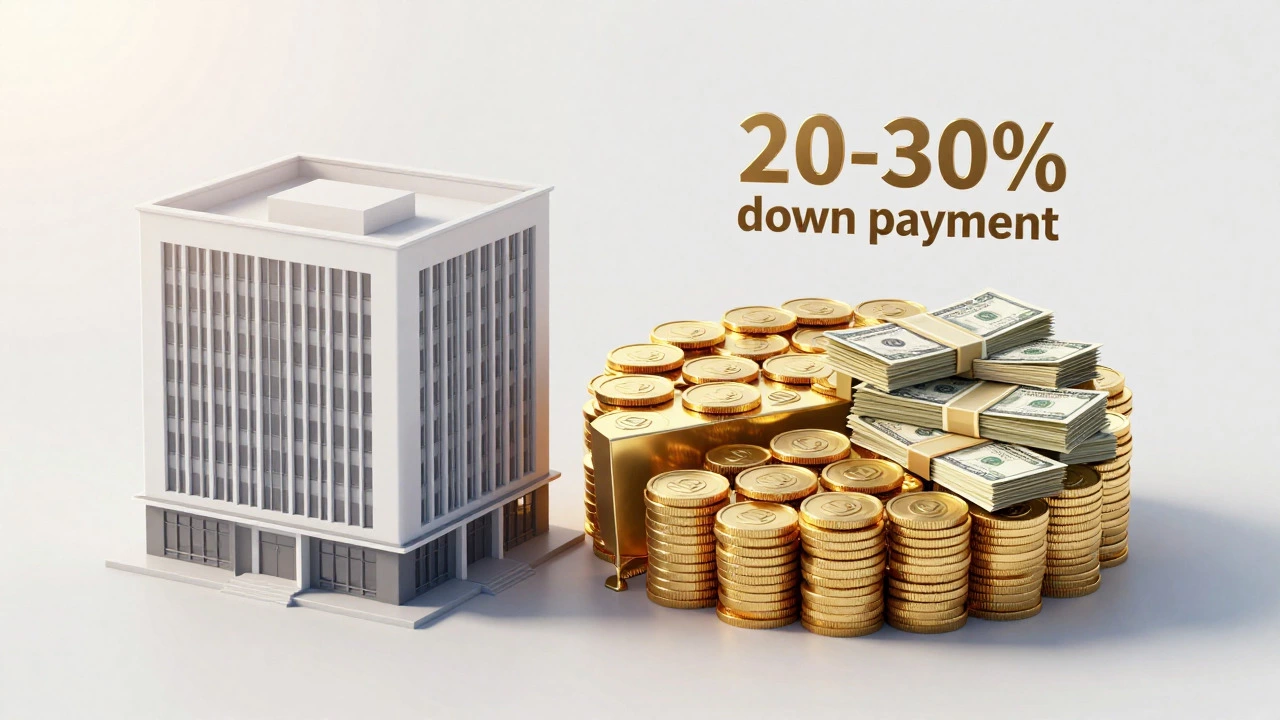
The short answer? The absolute lowest down payment you can get for a standard commercial loan is typically 10%. But let’s be real-that number usually comes with strings attached, specific loan programs, or government backing. For most conventional commercial mortgages, expect to put down between 20% and 30%. If you’re looking at niche properties or experienced borrowers, that number climbs even higher.
Why Commercial Lenders Demand More Cash Upfront
Before we dive into the numbers, it helps to understand why the bar is set so high. In residential lending, the government often steps in to guarantee parts of the loan through agencies like Fannie Mae or Freddie Mac. In commercial real estate, the borrower is responsible for everything. The lender doesn’t care about your personal feelings; they care about the cash flow of the property.
Commercial loans are unsecured by government guarantees (mostly). This means if the business inside the building fails, or if the market dips, the lender takes the hit. To protect themselves, they require a larger equity cushion. This is called the Loan-to-Value ratio, or LTV. If a property is worth $1 million and the lender offers an 80% LTV, you need to bring $200,000 to the table. That’s your 20% down payment.
Additionally, commercial loans often feature shorter terms-five, seven, ten, or fifteen years-compared to the thirty-year standard in housing. This means higher monthly payments, which increases the risk of default. A larger down payment lowers the principal balance, reducing the monthly payment and giving the lender more comfort.
The Sweet Spot: 20% to 30% Down
For the vast majority of commercial transactions involving small businesses, this is the range you’ll encounter. Let’s break down what happens at these levels.
20% Down Payment: This is generally considered the minimum for a well-qualified borrower purchasing a stable asset type. Think established medical offices, grocery-anchored retail centers, or fully occupied Class B industrial warehouses. To get this rate, you’ll need strong personal credit (usually above 700), two years of profitable tax returns, and a Debt Service Coverage Ratio (DSCR) of at least 1.25x. That DSCR number means the property’s net operating income must cover the debt service by 25% margin. If the rent drops slightly, you still pay the bank.
25% to 30% Down Payment: Most lenders prefer this range. It provides a healthy buffer against market fluctuations. If you’re buying a newer construction project, a mixed-use development, or a property in a secondary market location, lenders will likely push you toward 30%. At this level, you might find slightly better interest rates because the lender’s risk exposure is lower. You’re also more likely to negotiate favorable terms, such as longer amortization periods or fewer prepayment penalties.
Exceptions: How to Get Lower Than 20%
Is it possible to go lower? Yes, but you have to look outside the traditional commercial bank window. These options come with specific criteria and sometimes slower processing times.
SBA 504 Loans: The Small Business Administration (SBA) 504 program is one of the best tools for lowering down payments. Under this structure, a conventional bank lends 50%, a Certified Development Company (CDC) lends 40%, and you contribute just 10%. This is ideal for main street businesses buying their headquarters or manufacturing facilities. However, there are catch-22s: the property must benefit the job-creating business, and you need to prove the project will create or retain jobs. Also, the process is bureaucratic. Expect months of paperwork compared to weeks for a conventional loan.
SBA 7(a) Loans: While primarily for working capital, these can be used for real estate purchases under certain conditions. The down payment requirement varies widely based on the lender’s discretion and the collateral value, but 10% to 20% is common. These loans are harder to use for pure investment properties and work best when the real estate purchase is tied directly to business expansion.
FHA Multifamily Loans: If you’re buying an apartment building with five or more units, the Federal Housing Administration (FHA) offers long-term, fixed-rate financing with as little as 9% down. This is rare in commercial lending. The trade-off is personal recourse-you’re personally liable for the debt-and strict occupancy requirements. You must live in one of the units if it’s a smaller building, or manage it actively. The approval process is rigorous, focusing heavily on the physical condition of the building and the stability of the tenants.
Owner Financing: Sometimes the seller holds the note. If a landlord needs to sell quickly or wants passive income, they might accept a smaller down payment, say 10% to 15%, and finance the rest themselves. This bypasses bank underwriting entirely. You negotiate directly with the owner. The downside? Interest rates can be higher, and the terms are less standardized. Always have a lawyer review these agreements.
Factors That Influence Your Down Payment Requirement
Your down payment isn’t just a static number. It fluctuates based on several variables. Understanding these can help you prepare your offer and financial package.
- Property Type: Retail and industrial properties are seen as safer bets than hospitality or specialized medical facilities. A hotel might require 35% down due to volatile revenue streams, while a triple-net lease industrial park might only need 20%.
- Tenant Quality: Who is renting the space? A Fortune 500 company with a long-term lease reduces risk significantly. If the tenant is a mom-and-pop shop with a month-to-month agreement, the lender sees higher vacancy risk and demands more equity from you.
- Borrower Experience: Have you owned commercial real estate before? Lenders love track records. If you’ve successfully managed three other properties, they might waive some requirements or lower the down payment threshold. First-time buyers face steeper hurdles.
- Market Conditions: In 2026, interest rates have stabilized after the volatility of previous years, but lenders remain cautious. Tight credit markets mean higher down payments. When money is cheap and abundant, requirements loosen. Keep an eye on the Federal Reserve’s policies and local vacancy rates.
- Loan Size: Larger loans often face stricter scrutiny. A $2 million loan might have different underwriting guidelines than a $500,000 loan. Some banks have internal caps where loans over a certain size require additional collateral or higher equity contributions.
Hidden Costs Beyond the Down Payment
Don’t just budget for the down payment. Commercial closing costs are substantial. They typically range from 3% to 5% of the loan amount. This includes appraisal fees, environmental assessments, title insurance, legal fees, and origination points. Origination points are upfront interest charges paid to the lender, often 1% to 3% of the loan total. So, if you’re putting down 20%, make sure you have another 5% liquid for closing costs. Many deals fall apart because the buyer focuses solely on the down payment and runs out of cash at the wire transfer stage.
| Loan Type | Min. Down Payment | Best For | Key Restrictions |
|---|---|---|---|
| Conventional Commercial Mortgage | 20% - 30% | Standard office, retail, industrial properties | Strong credit, high DSCR required |
| SBA 504 Loan | 10% | Business owners buying headquarters/factories | Job creation requirement, lengthy approval |
| FHA Multifamily | 9% | Apartments with 5+ units | Personal recourse, strict occupancy rules |
| SBA 7(a) Loan | 10% - 20% | Small business expansion tied to real estate | Complex eligibility, limited to business use |
| Owner Financing | Negotiable (often 10-15%) | Quick sales, motivated sellers | Higher interest, non-standard terms |

Strategies to Reduce Your Out-of-Pocket Costs
If your cash reserves are tight, you aren’t completely stuck. Here are practical ways to bridge the gap.
Partnering: Bring in a silent partner who contributes capital in exchange for equity. You handle the management and operations; they provide the funds. This splits the down payment burden but also splits the profits. Clear legal agreements are essential here.
Seller Concessions: In a buyer’s market, you can negotiate for the seller to pay some of your closing costs or contribute to the down payment. This is tricky in commercial deals because lenders scrutinize the source of funds. The money must be “seasoned” (in your account for 60 days) and traceable. Seller concessions can help, but don’t count on them to cover the entire shortfall.
Bridge Loans: Use a short-term bridge loan to cover the down payment while you secure permanent financing. This is risky and expensive, with high interest rates. Only do this if you have a clear exit strategy, like refinancing within six months once the property is stabilized and appraised higher.
Home Equity Lines of Credit (HELOC): If you own your primary residence outright or have significant equity, you can tap into it. Lenders view HELOC proceeds as acceptable sources for down payments, provided you document the withdrawal properly. Just ensure your personal debt load doesn’t disqualify you from the commercial loan.
Common Pitfalls to Avoid
Making a mistake early in the process can cost you thousands in wasted fees or lost opportunities. Avoid these common traps.
Underestimating Repairs: Commercial properties often need immediate attention. Roofs, HVAC systems, and parking lots are expensive. If the appraisal comes in low due to deferred maintenance, your LTV goes up, and your down payment requirement jumps. Budget for repairs separately from your down payment.
Ignoring Environmental Issues: Phase I Environmental Site Assessments are mandatory for most commercial loans. If contamination is found, the lender may require remediation before funding, or they might pull out entirely. Factor this cost and timeline into your planning.
Overleveraging: Taking on too much debt across multiple properties can trigger cross-collateralization clauses. If one property struggles, the lender can seize assets from another. Keep your personal and business finances distinct and manageable.
Assuming Pre-Qualification Equals Approval: A letter of intent from a broker is not a commitment. Until the underwriter reviews your full file, including tax returns, bank statements, and property documents, nothing is guaranteed. Don’t sign a purchase agreement until you have a conditional commitment letter.
Next Steps for Your Commercial Purchase
Start by gathering your financial documents. Two years of personal and business tax returns, profit and loss statements, and balance sheets are standard. Then, identify the property type and its current cash flow. Calculate the Net Operating Income (NOI) by subtracting operating expenses from gross rental income. Divide the NOI by the desired cap rate to estimate the property value. Compare this to the asking price to see if the deal makes sense.
Approach multiple lenders. Community banks, credit unions, and national banks all have different appetites for risk. A local community bank might know the area better and offer flexible terms, while a national bank might have more capital but stricter algorithms. Shop around. The difference in down payment requirements and interest rates can save you hundreds of thousands of dollars over the life of the loan.
Can I get a commercial loan with 0% down?
Practically speaking, no. Unlike some residential loans, commercial lenders rarely offer 0% down. The closest option is an SBA 504 loan with 10% down, or potentially owner financing with negotiated terms. Zero-down commercial loans are extremely rare and usually involve complex structures like joint ventures where you contribute sweat equity instead of cash.
What is the best loan type for a first-time commercial buyer?
For first-time buyers, conventional commercial mortgages from community banks are often the most accessible path. They have transparent requirements and faster closing times than government-backed loans. If you are buying your own business location, explore SBA 504 loans for the lower 10% down payment option, despite the longer processing time.
How does my credit score affect the down payment?
A higher credit score can sometimes allow for a lower down payment or better interest rates. Generally, a score above 700 is preferred for competitive terms. Scores below 650 may result in higher down payment requirements, often 30% or more, or even denial. Lenders view credit history as a predictor of future reliability.
What is Debt Service Coverage Ratio (DSCR)?
DSCR is a critical metric for commercial loans. It measures the property's net operating income divided by its annual debt service. Lenders typically require a DSCR of at least 1.25x, meaning the property generates 25% more income than needed to cover the loan payments. A higher DSCR indicates a safer investment for the lender.
Do I need to occupy the commercial property?
Not necessarily. Investment properties where you are a passive landlord are common. However, if you are using an SBA 504 loan, the property must primarily benefit your business, which often implies ownership or significant control. FHA multifamily loans may require active management or residency depending on the unit count.
How long does it take to close a commercial loan?
Closing times vary widely. Conventional loans can close in 30 to 60 days. SBA loans often take 60 to 90 days due to federal review processes. Owner financing depends on negotiation speed. Delays are common due to appraisals, environmental reports, and title issues, so build buffer time into your purchase agreement.