
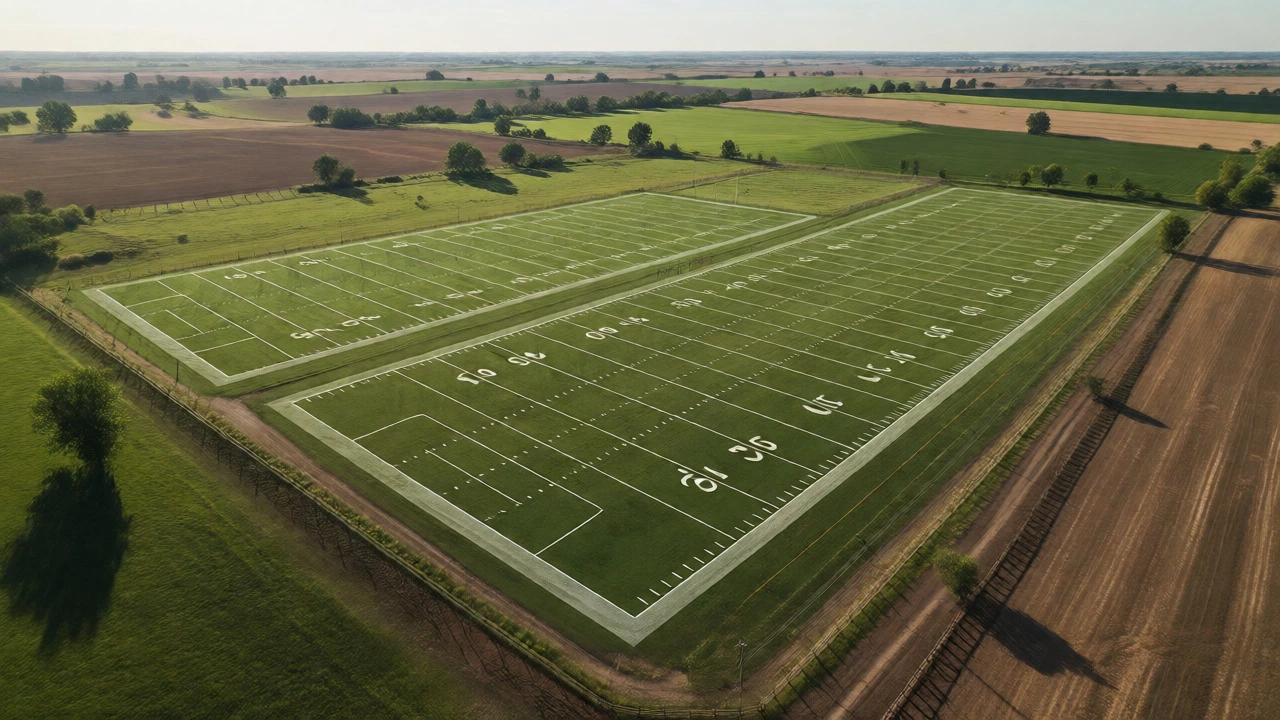
Land Size Visualizer: Acres to Football Fields
Enter acres and click calculate to see the comparison.
0 Fields
Equivalent to your input area
Per Field Area: 0 sq ft
Quick Reference Table
| Sport / Field Type | Dimensions (Approx.) | Area (Sq Ft) | Fields in 20 Acres |
|---|---|---|---|
| American Football (with end zones) | 360 ft x 160 ft | 57,600 | ~15.1 |
| American Football (gridiron only) | 300 ft x 160 ft | 48,000 | ~18.1 |
| Soccer Pitch (FIFA Standard) | 393 ft x 246 ft | 96,678 | ~9.0 |
You’re standing on a patch of dirt, looking at a listing that says "20 acres for sale." The number sounds big. It definitely sounds bigger than your backyard. But how big is it really? If you try to picture it, your brain probably hits a wall. That’s why real estate agents and buyers often use football fields as a mental ruler. It’s a familiar shape, a known quantity, and suddenly, abstract numbers become something you can actually visualize.
Here is the quick answer before we get into the weeds: 20 acres is roughly equal to 15 American football fields, including the end zones. If you exclude the end zones and just look at the playing gridiron, it’s closer to 18 fields. This distinction matters because when you are out walking the land, you need to know what you are measuring against. Let’s break down exactly how this math works, why it varies by sport, and what 20 acres actually looks like in terms of practical use.
The Math Behind the Acre
To understand why the number isn’t always the same, you have to look at the definitions. An acre is a unit of area used primarily in the United States and other countries that follow the imperial system. One acre equals exactly 43,560 square feet. It doesn’t matter if the plot is a perfect square, a long thin strip, or an irregular blob; if it covers 43,560 square feet, it is one acre. Twenty acres, therefore, is 871,200 square feet.
Now, let’s look at the American football field. A standard NFL field is 360 feet long (including two 10-yard end zones) and 160 feet wide. Multiply those dimensions, and you get 57,600 square feet per field. When you divide the total area of 20 acres (871,200 sq ft) by the area of one field (57,600 sq ft), you get approximately 15.12. So, yes, 20 acres fits about 15 full-size football fields with room to spare for the sidelines.
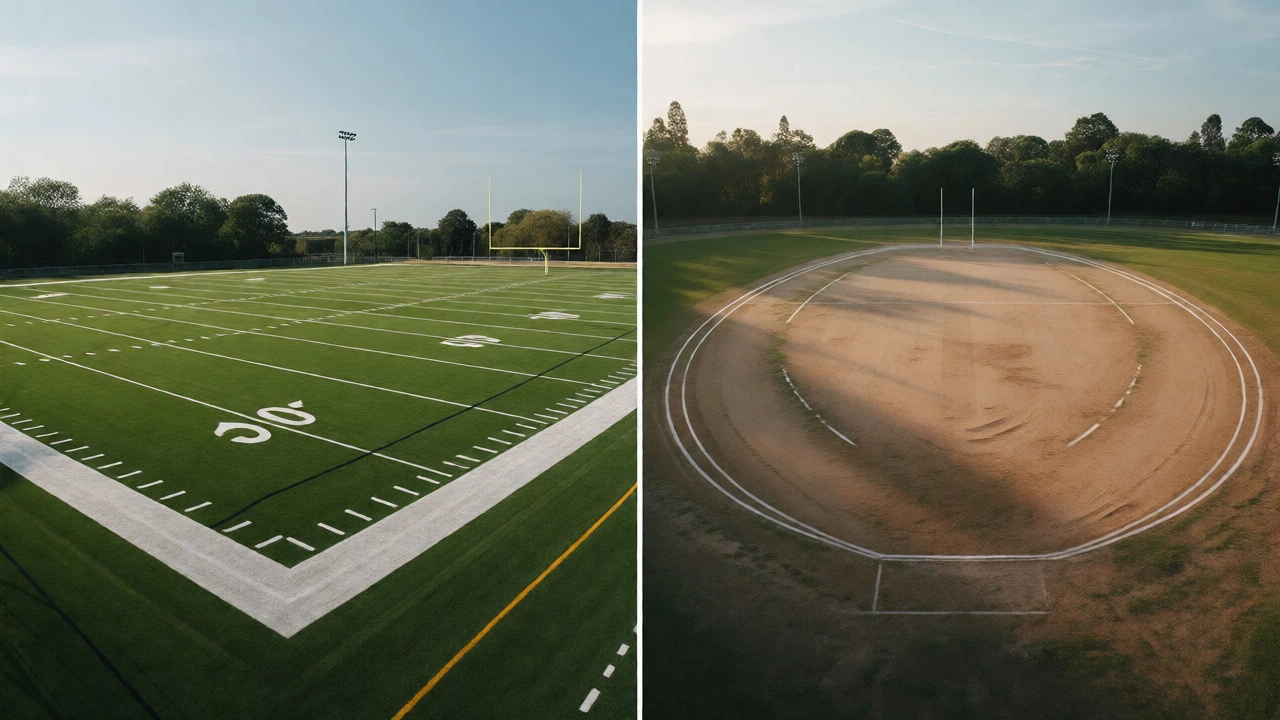
But wait-what if you are thinking of soccer? Or rugby? The sizes differ, which changes the visualization entirely. This is where context becomes critical. If you are in Australia, where I live, you might be picturing an Australian Rules Football oval. Those are much larger. A standard AFL ground is roughly 135-155 meters long and 110-150 meters wide. That’s significantly more space than an American gridiron. Using the wrong "field" analogy can lead to massive misunderstandings about land value and usability.
| Sport / Field Type | Dimensions (Approx.) | Area (Sq Ft) | Fields in 20 Acres |
|---|---|---|---|
| American Football (with end zones) | 360 ft x 160 ft | 57,600 | ~15.1 |
| American Football (gridiron only) | 300 ft x 160 ft | 48,000 | ~18.1 |
| Soccer Pitch (FIFA Standard) | 393 ft x 246 ft | 96,678 | ~9.0 |
| Australian Rules Oval | Varies (Avg ~145m x 130m) | ~190,000+ | ~4.6 |
Visualizing the Shape Matters
Area is just one part of the equation. Shape dictates utility. You could have 20 acres arranged as a perfect square, or you could have it as a long, narrow ribbon of land. Both are 20 acres, but they function completely differently.
If the land is a perfect square, each side would be approximately 933 feet long. That’s nearly three football fields laid end-to-end. Imagine driving down a road and counting off three lengths of a stadium. That’s the frontage. Now, imagine that same 20 acres stretched out into a strip that is only 100 feet wide. To get 871,200 square feet, the length would need to be over 8,700 feet-that’s more than a mile and a half deep. Walking that distance takes time, and building on it requires different engineering considerations, such as longer driveways and extended utility lines.
When you are evaluating land for sale, ask yourself: Do I want a compact block where everything is close together? Or do I want depth for privacy and separation from neighbors? The "football field" metric helps you grasp the sheer volume of land, but the topography and boundary lines determine whether that land is actually usable for your specific goals.
What Can You Actually Do With 20 Acres?
Twenty acres is a sweet spot in the real estate market. It’s too small for large-scale commercial farming but too big for a typical suburban home lot. This size offers genuine autonomy without requiring the heavy machinery of industrial agriculture. Here are some common uses for a parcel of this size:
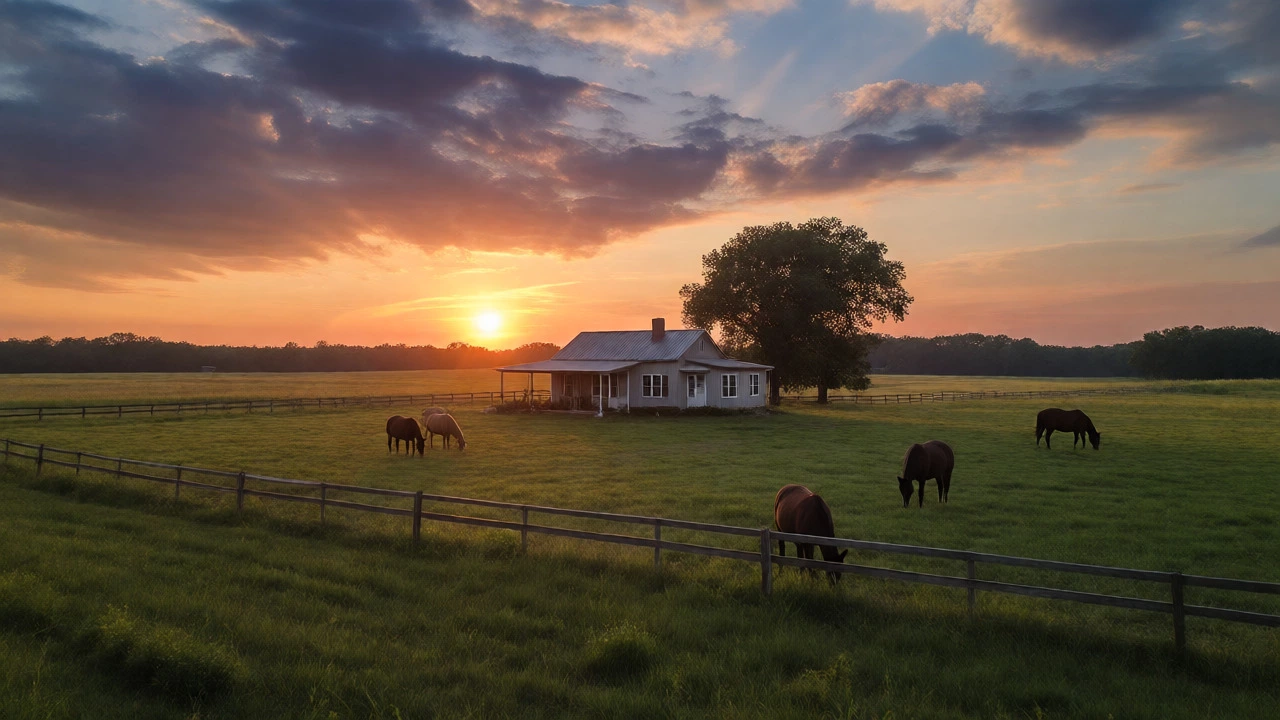
- Small-Scale Homesteading: You can comfortably keep horses, goats, or sheep. Four horses typically require 1-2 acres of pasture each, depending on soil quality and climate. With 20 acres, you could sustainably manage a small herd while still having room for crops, orchards, and a residence.
- Recreational Retreat: Many buyers purchase 20 acres simply for space. It’s enough land to build a main house, a guest cabin, and perhaps a barn or workshop, all set back far enough from the road to ensure quiet and privacy.
- Timber Management: In many regions, 20 acres is sufficient to maintain a healthy tree stand. You can harvest timber selectively without depleting the resource, turning the land into a slow-generating asset.
- Subdivision Potential: Depending on local zoning laws, 20 acres might be divisible into multiple smaller lots. If minimum lot sizes are 5 acres, you could potentially split the land into four parcels. This is a major factor for investors looking to flip land.
It’s worth noting that zoning regulations vary wildly by county and municipality. Just because you own 20 acres doesn’t mean you can put a mobile home on it or run a business from the garage. Always check the local planning department before assuming the land will support your intended use.
Common Misconceptions About Land Size
One of the biggest mistakes buyers make is confusing visual appearance with actual acreage. A flat, open field looks huge. A wooded hillside of the same size feels smaller because trees obscure the horizon and slopes reduce the perceived horizontal distance. This is called "effective acreage." If half your land is steep slope or wetland, your usable area drops significantly.
Another misconception is that fences define boundaries accurately. Survey errors happen. Old fence lines don’t always match legal descriptions. If you are buying 20 acres based on a casual walk-through, hire a licensed surveyor. They will place stakes at the corners, giving you the true geometric reality of the property. Don’t rely on the seller’s estimate or the neighbor’s opinion of where the line falls.
Also, consider the impact of terrain. A 20-acre plot in Kansas looks very different from a 20-acre plot in Vermont. Flat land is easier to farm and build on. Rocky or heavily forested land requires clearing, grading, and sometimes blasting rock. These costs add up quickly. When comparing properties, adjust your price-per-acre expectation based on the "improvement cost," not just the raw land price.
Practical Tips for Evaluating Your Parcel
If you are seriously considering a 20-acre property, here is a checklist to help you move from curiosity to contract:
- Get a Topographic Map: Look for contour lines. Tight lines mean steep slopes. Wide spacing means flat land. This tells you where water runs and where you can build.
- Check Access Rights: Does the property have a public road frontage? Or is it landlocked behind someone else’s driveway? Easements can restrict how you use your access path.
- Investigate Utilities: How far is the nearest power pole? Running electricity 1,000 feet can cost $10,000 or more. Water sources are equally critical. Is there a well? Is the water table high or low?
- Review Soil Tests: For agricultural use, soil quality is paramount. For construction, soil stability determines foundation costs. Clay-heavy soils expand and contract with moisture, which can crack foundations if not properly engineered.
- Walk the Perimeter: Don’t just drive through. Walk the boundaries. Look for signs of flooding, illegal dumping, or encroachment by neighbors’ structures.
Remember, the goal isn’t just to buy land; it’s to buy land that works for your life. The football field analogy gets you started, but due diligence keeps you safe.
Is 20 acres considered a lot of land?
In rural areas, 20 acres is often seen as a starter size for hobby farms or private retreats. In suburban fringe areas, it is considered substantial and highly desirable for its privacy potential. Compared to typical residential lots (often 0.25 to 0.5 acres), 20 acres is exceptionally large, offering significant freedom and space.
Can you build a house on 20 acres?
Yes, absolutely. Most zoning codes allow residential construction on parcels of this size. However, you must verify setbacks (distance from roads and property lines), septic system requirements, and well placement rules. Some areas may require environmental impact assessments if the land contains wetlands or protected habitats.
How long does it take to walk 20 acres?
If the land is a square, walking around the perimeter takes about 15-20 minutes at a moderate pace. Walking across the center diagonally might take 5-10 minutes depending on terrain. Rugged or wooded terrain will significantly increase travel time compared to flat, cleared fields.
Why do realtors use football fields to describe land?
Most people struggle to visualize large units of measurement like acres or hectares. Football fields provide a relatable, standardized reference point. Since most adults have seen a football game, they can mentally stack these familiar shapes to gauge scale, making the abstract concept of acreage more concrete and understandable.
Does the shape of the land affect its value?
Yes. Square or rectangular parcels are generally more valuable and easier to sell than irregularly shaped ones. Odd shapes can waste usable space, complicate fencing, and limit building options. Buyers prefer efficient layouts where every foot of land serves a purpose.