
Commercial Real Estate Cash Flow Calculator
Calculate if a commercial property will generate positive cash flow after expenses and mortgage payments. Based on real examples from the article.
Results
People see luxury office towers, shopping centers, and warehouse districts and think: commercial real estate is where millionaires are made. And sure, some people have gotten rich from it. But here’s the truth most guides won’t tell you: becoming a millionaire from commercial property isn’t about luck or buying the first building you see. It’s about patience, strategy, and understanding the real math behind the numbers.
It’s not about the building-it’s about the cash flow
A lot of beginners think buying a $2 million office building means they’re one step away from wealth. But if that building sits 40% empty, and the tenant who pays rent gets evicted next month, you’re not a millionaire-you’re just a landlord with a big mortgage. The real measure of success in commercial real estate isn’t the sale price. It’s the net operating income (NOI). That’s the rent you collect after paying property taxes, insurance, maintenance, and management fees.
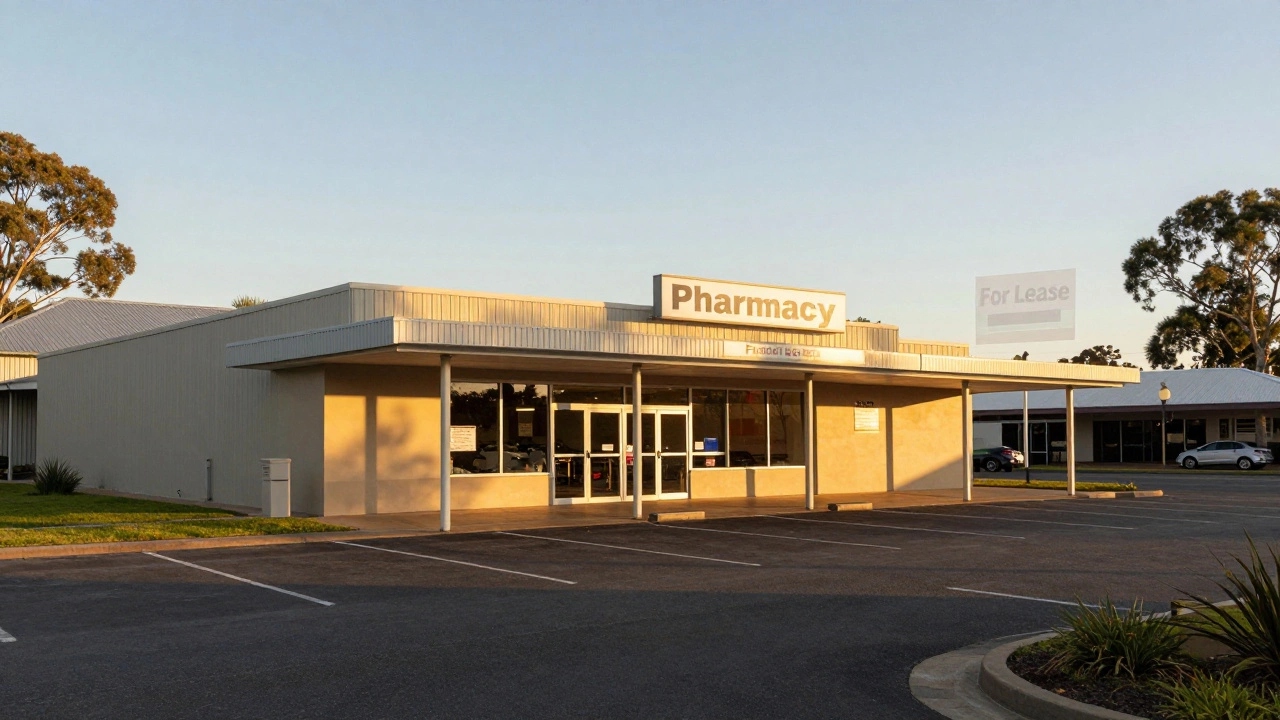
Take a single-tenant retail strip center in Melbourne’s eastern suburbs. It’s listed for $3.2 million. The tenant, a pharmacy chain, pays $210,000 a year in rent. Property taxes and insurance? Around $65,000. Maintenance and management? Another $35,000. That leaves you with $110,000 in NOI. At a 6% cap rate (which is average for stable retail assets), the property is priced right. But here’s the catch: that $110,000 isn’t profit. You still have a loan. Let’s say you put down 30% ($960,000) and borrowed $2.24 million at 7% interest over 25 years. Your monthly payment? About $16,000. That’s $192,000 a year. You’re now losing $82,000 annually before taxes. That’s not wealth. That’s a cash drain.
The key? Buy properties where cash flow covers the mortgage-and then some. A well-structured triple-net lease (NNN) on a medical office building in Sydney’s northwest, for example, might bring in $180,000 a year in rent, with the tenant paying all taxes, insurance, and repairs. Your only costs are management (say, $10,000) and a $90,000 mortgage payment. That leaves you with $80,000 in free cash. Do that on three properties, and you’re making $240,000 a year before taxes. That’s how real wealth builds.
Location isn’t everything-but tenant quality is
You can have the best corner lot in the CBD, but if your tenant is a struggling café that closes in 18 months, you’re stuck with a vacant space and no income. Commercial tenants aren’t like residential renters. They sign leases for 5, 10, even 20 years. And when they leave, they take your income with them.
Look for tenants with strong balance sheets: national pharmacy chains, government agencies, big-box retailers like Aldi or Bunnings, or healthcare providers. These are the ones that pay rent reliably-even during recessions. A 2024 report from CBRE showed that properties leased to government or healthcare tenants had vacancy rates under 3% in Australia, while retail spaces tied to small businesses hit 11%. That’s not a small difference. It’s the difference between sleeping at night and getting calls at 2 a.m. because the tenant vanished.
Also, watch lease terms. A tenant paying $100,000 a year with a 3% annual rent increase is worth far more than one paying $120,000 with no increases. Over 10 years, that 3% growth turns $100,000 into $134,000. That’s $340,000 in extra income just from smart lease structure.
You need more than one property-and time
One commercial property won’t make you a millionaire. Not unless you bought it in 2008 for $500,000 and it’s now worth $4 million. But that’s not how most people do it. Most build wealth slowly, one property at a time.
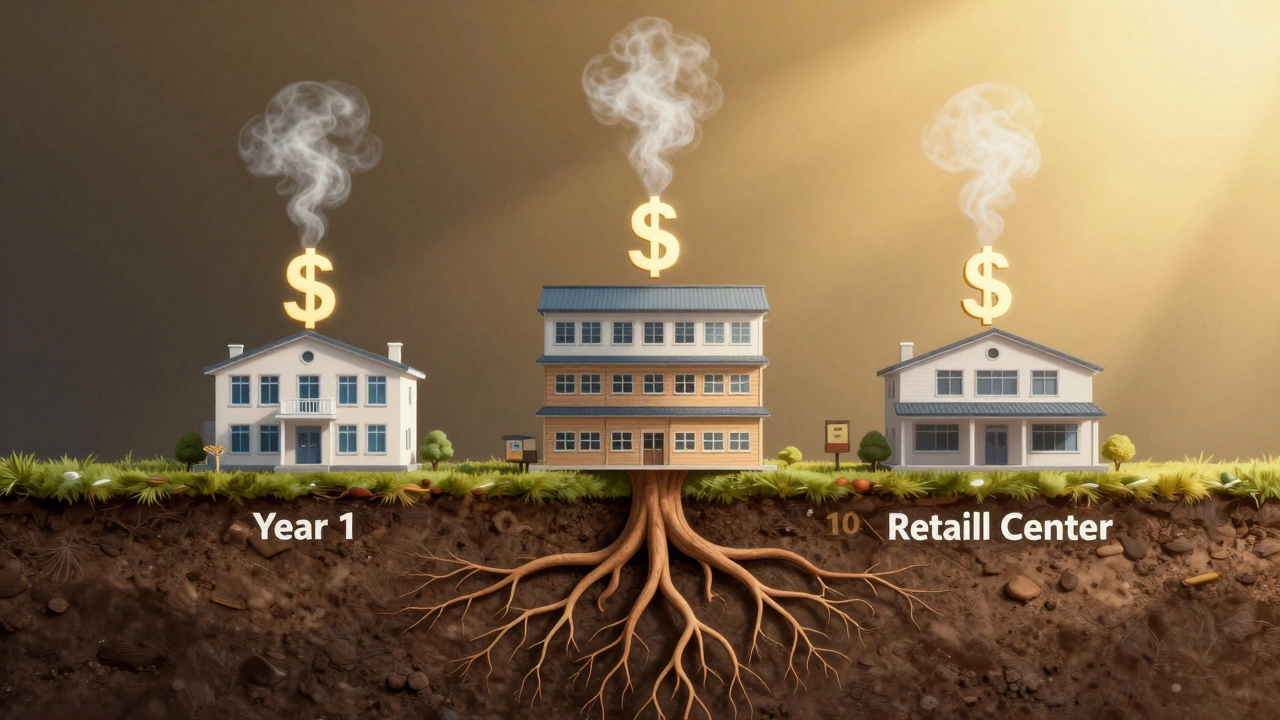
Let’s say you start with a $1.2 million warehouse in Brisbane’s industrial belt. You put down $360,000 (30%), borrow $840,000, and rent it to a logistics company for $85,000 a year. After expenses and mortgage, you net $40,000 a year in cash flow. You reinvest that into a second property-a $900,000 medical clinic in Perth, with a 10-year lease to a private practice. You put down $270,000 and net $35,000 a year. Now you’re making $75,000 annually from two properties.
By year five, you’ve paid down $300,000 in principal across both loans. You refinance one property, pull out $400,000 in equity, and buy a third-this time a $1.8 million retail center with three tenants. You now own three assets worth $3.9 million. Your annual cash flow? $140,000. Your equity? Over $2 million. You’re not a millionaire yet, but you’re close. By year 10, with continued rent growth and property appreciation, you’re sitting on $5 million in assets and $220,000 in annual income. That’s when you stop working for money-and money starts working for you.
It’s not a get-rich-quick scheme. It’s a get-rich-slow game
There are no shortcuts. No app that finds “undervalued” commercial properties with a click. No YouTube gurus selling a $497 course that guarantees six figures in six months. If someone tells you that, they’re selling you a dream-not a business.
Real commercial real estate investing is slow. It takes 3-5 years to build a track record with lenders. It takes 2-3 years to learn how to analyze a lease. It takes another 2 years to find good deals without paying premium prices. Most people give up before they even get started.
But here’s what happens to those who stick with it: they don’t become overnight millionaires. They become multi-millionaires. Not because they got lucky. Because they kept showing up. They learned to read financial statements. They hired a good property manager. They avoided emotional buys. They waited for the right deal-and walked away from the rest.
What you need to start (and what you don’t)
You don’t need $5 million in savings. You don’t need to be a real estate agent. You don’t even need to be rich. But you do need:
- At least $300,000 in cash or equity-for down payments, closing costs, and 6 months of reserves
- A good accountant-commercial property has complex tax rules, depreciation schedules, and GST implications
- A commercial mortgage broker-banks treat commercial loans differently. You need someone who knows how to structure them
- Patience-you’ll spend months on one deal. That’s normal
- Discipline-you won’t buy every property you see. You’ll wait for the right one
What you don’t need: a real estate license, a flashy website, or a LinkedIn post about your “first $1M deal.” Those things don’t pay your mortgage. Cash flow does.
Common mistakes that kill commercial deals
Most people who try commercial real estate fail-not because they’re bad investors, but because they make the same mistakes over and over:
- Buying based on square footage-a 5,000 sqm warehouse isn’t worth more than a 3,000 sqm one if the tenant is weak
- Ignoring lease expiration dates-a property with a lease ending in 12 months is a ticking time bomb
- Underestimating vacancies-even good tenants leave. Budget for 3-6 months of lost rent
- Not reading the lease-a tenant might have the right to sublease, terminate early, or demand repairs you didn’t know about
- Over-leveraging-if interest rates jump 2%, can you still afford the payment?
One investor I know bought a $2.4 million office building in Adelaide because the seller said it was “prime.” He didn’t check the tenant’s credit. The tenant went bankrupt. He lost $400,000 in equity and spent 18 months finding a new tenant. That’s not an exception. It’s the rule for people who skip due diligence.
Who really makes money in commercial real estate?
It’s not the flashy guys with Lambos. It’s the quiet ones: the accountant who bought three medical centers over 15 years. The retired teacher who bought a chain of laundromats. The engineer who reinvested his salary into industrial units in Western Sydney. They didn’t get rich fast. But they didn’t lose everything either.
They built portfolios. They let time do the work. They focused on income, not hype. And when the market turned, they didn’t panic-they adjusted. They raised rents. They renegotiated leases. They held on.
If you want to become a millionaire from commercial real estate, don’t chase the next big deal. Chase the next smart one. The one with a strong tenant. The one with a long lease. The one that pays you every month-rain or shine.
That’s how it’s done.
Can you become a millionaire from one commercial property?
It’s possible, but extremely rare. You’d need to buy a property at the right time-like in the early 2000s-and hold it for 20+ years with strong appreciation and rent growth. Most people build wealth across multiple properties over 10-15 years. One property can be a foundation, but not the whole house.
How much money do you need to start?
You typically need 25-35% of the property’s value as a down payment. For a $1 million property, that’s $250,000-$350,000. You also need reserves for repairs, vacancies, and closing costs-another $50,000-$100,000. So, $300,000-$450,000 is a realistic starting point.
Is commercial real estate better than residential?
It depends. Commercial offers higher cash flow and longer leases, but it’s harder to get financing, harder to find tenants, and more complex to manage. Residential is easier to start with, but returns are lower. Commercial is better for building long-term wealth if you’re willing to learn the system.
What’s the best type of commercial property to start with?
For beginners, single-tenant NNN retail (like a pharmacy or bank branch) or medical office buildings are the safest. They have stable tenants, long leases, and lower management demands. Industrial warehouses are also strong if located near transport hubs. Avoid multi-tenant retail or office buildings until you have more experience.
Do you need a real estate agent to buy commercial property?
Not legally, but it’s strongly recommended. Commercial deals involve complex contracts, lease reviews, and zoning rules. A good commercial agent knows which deals are truly good and which are traps. They also have access to off-market listings-where the best opportunities hide.